Tam Cốc (meaning “Three Caves”) is one of Vietnam’s most famous scenic river valleys — where the Ngô Đồng River winds through emerald rice paddies, under three dramatic limestone caves, and past small riverside villages. It’s often dubbed “Halong Bay on land,” but Tam Cốc offers something quieter and more human-scaled: sampans rowed by locals, flat fields framed by karsts, and a gentle pace that invites slow wandering.
Visitors come here for a mix of scenery, boat rides, light adventure and countryside calm.
Best Time to Visit Tam Cốc for Rice Fields
- Late May to early June – This is the golden season when the rice fields along the Ngô Đồng River turn bright yellow, contrasting beautifully with the green limestone mountains. It only lasts about 2–3 weeks, so timing matters.
- February to April – The rice paddies are a fresh green after planting season, and the weather is cooler and pleasant for boat rides and cycling.
👉 If you want those iconic photos of boats gliding between golden rice paddies, aim for late May or early June.

What to See & Do
- Boat Ride on Ngo Đồng River & Three Caves
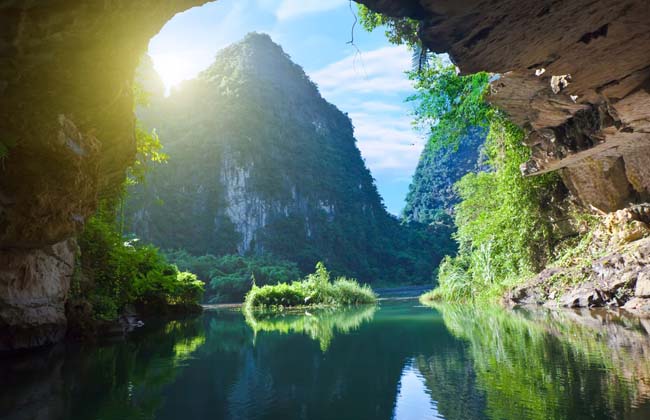
The signature Tam Cốc experience is a 1.5 – 2 hour sampan ride along the Ngo Đồng River. Your rower (often a local woman) will navigate you gently through rice fields and then steer the boat through three natural caves: Hang Cả, Hang Hai, and Hang Ba.
Each cave has its own character — Hang Cả is the longest and usually the darkest, Hang Ba lets more light through, and floating through each tunnel under the karst adds a sense of quiet wonder.

- Bích Động Pagoda Complex
Just a short bike or walk from the boat pier, Bích Động is a serene pagoda-in-a-mountain complex. With lower, middle, and upper pagodas connected by staircases and carved into limestone hillsides, it offers a gentle spiritual contrast to the watery boat ride.
From the upper pagoda or nearby vantage points you can look out over the rice paddies and karst hills—especially beautiful in early morning or late afternoon light.
- Climb to Hang Múa Viewpoint
If you’re up for a bit of effort, climbing the ~500 steps up to the Hang Múa (“Múa Cave”) viewpoint delivers one of the best panoramic views of Tam Cốc valley.
From the top, the Ngo Đồng River snakes through emerald fields and rounded karst peaks—a sweeping vista that often lures photographers and those seeking a classic Southeast Asian landscape.
- Cycle or Walk the Countryside
After (or before) the boat ride, renting a bicycle to ride along the dikes and rural roads adds a slower-paced dimension to the trip. You’ll pass through flat rice paddies, small village houses, lotus ponds, and occasional karst outcrops.
It’s peaceful, photogenic, and gives you more control over pace—plus, you’re more likely to stumble on quiet cafés, mango orchards, or a local home stay.
- Optional Nearby Stops
If you’ve got time, here are solid extensions:
- Thai Vi Temple — a quiet, scenic temple located a couple of kilometers from the boat dock, offering a gentle cultural complement to the natural scenery.
- Thung Nham Bird Park — nearby wetland/bird sanctuary where you can boat through flooded forest niches, spot water birds, and sometimes join a short hike to a bird hide.
- Rice-field Photography and Village Life — simply pausing to sit by the paddies, watch farmers, talk to locals, or drift into a quiet lane can be among the most memorable parts of Tam Cốc.
When I visited Tam Cốc early one June morning, I stepped onto a wooden sampan at dawn. The river was glassy and still. As the rower gently paddled us forward, the karst cliffs rose directly from the water, rice paddies glowed golden in the rising sun, and clouds drifted low. We passed under the first cave, where the air cooled and the light dimmed. Emerging into a lagoon, the reflection of cliffs in water made everything feel doubled, magical, and serene.
After the boat ride, I rented a bicycle and rode along a narrow country road. Every turn revealed a new angle: a cornered cluster of stilt houses, mothers tending vegetable gardens, children crossing a wooden footbridge, and endless green fields framed by karst silhouettes. I climbed to the Hang Múa viewpoint just as the sun cleared the horizon, and the sweep of Tam Cốc laid out below me felt like a living postcard.
By noon, I realized Tam Cốc isn’t just a place to look at — it’s a place to drift through, slow down in, and absorb.