Located in Ninh Binh province about 120km from Hanoi City, Cuc Phuong is Vietnam’s first national park, established in the 1960s, and remains one of the country’s richest biodiversity hotspots. It covers dense tropical forests, misty limestone valleys, ancient trees, deep caves, and is home to rescue and conservation centers for endangered primates, turtles, and native wildlife. If you want a nature-oriented trip outside the usual tourist track—a mix of trekking, wildlife spotting, cultural immersion, and slow travel—Cuc Phuong is ideal.
Let’s go and discover Cuc Phuong the whole exceptional world inside this primary forest and visit the most prominent tourist attracting point below:
Top Activities & What to See
- Primate Rescue Center & Wildlife Conservation
One of the park’s standout features is its Endangered Primate Rescue Center, where rescued langurs, gibbons and other primates are rehabilitated and studied before being reintroduced to semi-wild reserves. You’ll also find a turtle conservation center, botanical gardens, and a museum displaying archaeological discoveries and specimens of the park’s fauna and flora.

2. Bird-watching & Wildlife Spotting
Cúc Phương is home to over 300 species of birds and a rich array of mammals, amphibians, insects and reptiles—many of which are endemic to Vietnam or Southeast Asia. Guided early-morning and late-afternoon bird-watching can yield silver pheasants, hornbills, woodpeckers or even the elusive giant flying squirrel.
3. Trekking, Cycling & Jungle Trails
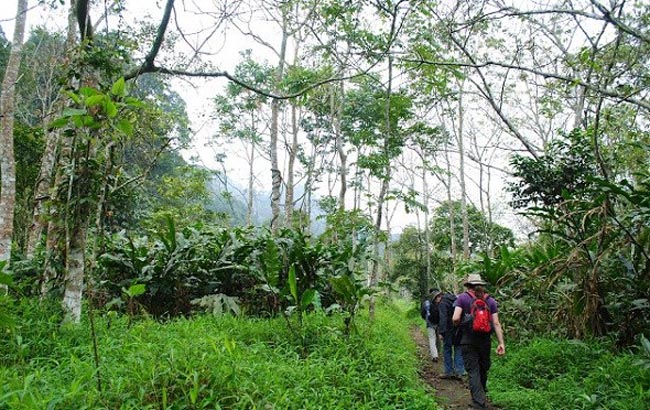
The park offers a mix of hiking and cycling trails—some easy and well-marked, others steeper or deeper. Popular excursions include trekking to ancient trees, hill viewpoints, jungle canopy walks or biking between forest valleys.
This thousand-year tree is also very tall (around 45 meters) but its diameter is fourth times compared to the diameter of Dang ancient tree. It need at least 20 adults with their arm length full to embrace completely the whole tree trunk. Let’s trek about 3 km to meet this special wonder of the Mother Nature here. Besides, near the Thousand-year tree location, there is small track leading to Son Cung Cave that owning many very beautiful stalactites.


4. Cave Exploration & Archaeology
Cúc Phương’s karst terrain shelters several caves with archaeological importance. Sites like the Cave of Prehistoric Men offer a window into human habitation from 7,000–12,000 years ago, plus fossils and relics. Guided cave tours can be fascinating, combining geology, paleontology and a sense of mystery.

5. Kayaking & Water Activities
You can rent kayaks on Mac Lake or Yen Quang Lake inside or near the park boundaries—an excellent way to explore quieter forest waterways and enjoy a slower pace.
6. Muong Village Homestays & Traditional Culture
Cúc Phương is surrounded by Muong ethnic minority villages. Many have opened community-based tourism homestays, where visitors can experience daily rural life, local music and dance performances, traditional stilt-houses, and meals cooked over a fire. Evening folk music, storytelling and bamboo rafting or slow river boating can round out the cultural.
When I visited, I stayed two nights in a Muong homestay at the edge of the forest. My first morning began before dawn, boarding a small motorboat to slip silently into a misty stream on Yen Quang Lake. The still water reflected ancient trees and limestone hills, and I felt like I was paddling through a living painting.
Later that day, I walked into the primate rescue center, watching carefully as slow lorises and langurs were fed and monitored. One juvenile langur, rehabilitated after a poaching incident, cautiously approached a branch offered by a caretaker. It was a humbling moment—reminding me how fragile and precious this forest is.
In the afternoon I cycled along a forest trail where the shadows shifted quickly. A sudden flurry of wings announced a flock of butterflies, which drifted lazily through sunlit clearings. At night, I joined a ranger-led night walk: fireflies blinked among ferns, and I tracked the distant cry of gibbon calls. By the time I slept under a simple thatched roof, I felt deeply rooted in the pace of the forest.